
Darshan Safety Zone
Back to Insightssignature fiberglass fabric navi mumbai · Featured
Specify Industrial Fiberglass Cloth

In this article
Industrial fiberglass cloth is the white E-glass sheet you specify when a pipe, duct, or equipment face in the plant is too hot to leave bare.
You might be raising that indent for a pipe rack in Taloja, a boiler house on an MIDC estate, or a fabrication bay that serves the port. The cloth does not change with the pin code. Match the surface, the model’s listed temperature, and the metres you need.
Match the cloth to the hot surface
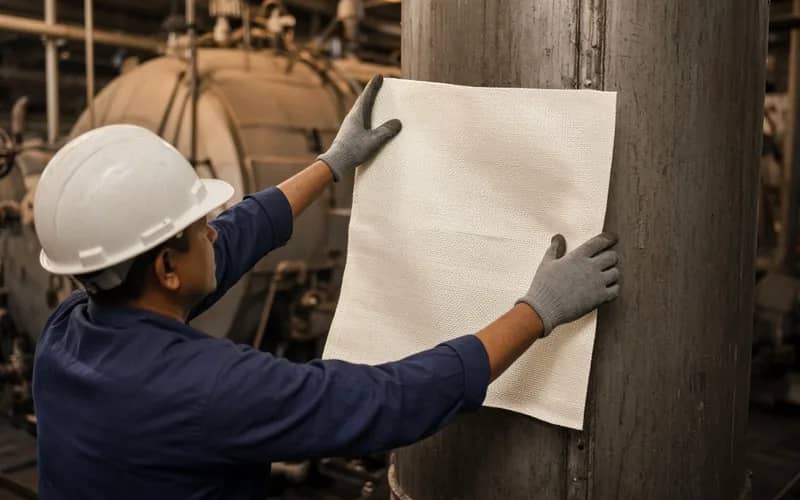
You are the person who has to name the material on the requisition. The fitter is waiting, the line is still warm from the last run, and a line that only says “fiberglass cloth” comes back as the wrong sheet.
Signature Fiberglass Cloth is an uncoated white cloth woven from 100% E-glass. You cut it and you wrap it. It is not a finished fire blanket, and it is not a foil-faced or graphite-coated cloth.
Put it on the jobs this cloth is listed for.
- Pipe and duct wrap: a steam line, an exhaust duct, or a flange you still have to lag.
- Furnace and boiler shields: a sheet between a hot casing and the walkway beside it.
- Equipment barriers: a layer over a hot housing while the crew works next to it.
- Fabrication detail: a piece cut to the opening in front of you, not a catalogue blanket size.
Walk the job before you raise the indent. Write what the cloth will touch, whether it stays up after start-up, and who will cut it. A pipe wrap and a boiler shield want different thicknesses, even when they sit in the same shed.
Navi Mumbai does not get a special cloth. A pipe rack in Taloja, a boiler house on an MIDC estate, and a fabrication bay that serves the port all draw from the same models. What changes is the surface in front of you. Name that surface so stores does not guess.
If the drawing already calls for a coated fabric, stop and check the drawing again. This cloth is bare E-glass. A silver foil face belongs on Signature Aluminum FG Cloth, and a dark graphite face belongs on Signature Graphite FG Cloth. Swapping the bare cloth in will not match the drawing.
On the indent, write the job in a few plain words, such as “steam pipe wrap, stays on”. That line stops the wrong roll leaving stores.
Read the temperature on the model
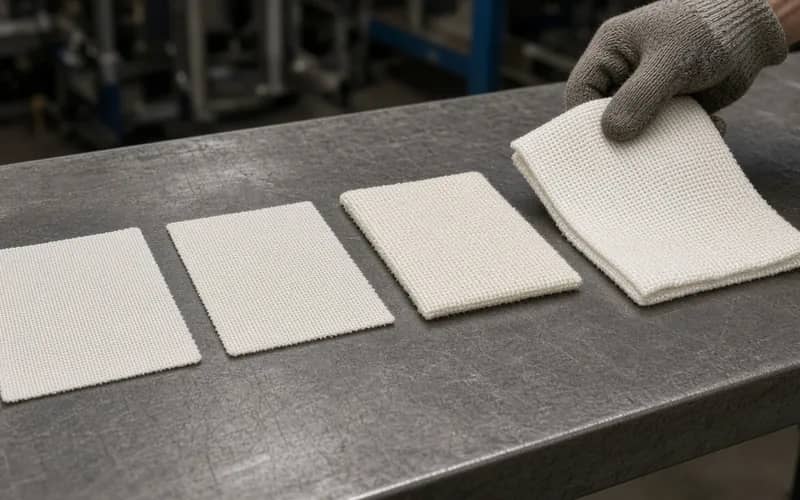
The habit on old indents is to write one temperature for every roll. That habit misses this cloth. Signature Fiberglass Cloth has fourteen DSZFG models. Thickness runs from 0.1 mm to 3.0 mm. Weight runs from 200 GSM to 1850 GSM. The working temperature sits on the model row, not on the family name.
Read the row you are about to order. The models fall into three listed windows.
- 550 °C to 800 °C: DSZFG0.1 at 0.1 mm and 200 GSM, DSZFG0.18 at 0.18 mm and 200 GSM, DSZFG0.2 at 0.2 mm and 200 GSM, and DSZFG0.4 at 0.4 mm and 300 GSM.
- 600 °C to 900 °C: DSZFG0.5 at 0.5 mm and 420 GSM, and DSZFG0.6 at 0.6 mm and 430 GSM.
- 650 °C to 900 °C: DSZFG0.3 at 0.3 mm and 200 GSM, DSZFG0.8 at 0.8 mm and 800 GSM, DSZFG1.0 at 1.0 mm and 840 GSM, DSZFG1.2 at 1.2 mm and 900 GSM, DSZFG1.5 at 1.5 mm and 950 GSM, DSZFG2.0 at 2.0 mm and 1050 GSM, DSZFG2.5 at 2.5 mm and 1300 GSM, and DSZFG3.0 at 3.0 mm and 1850 GSM.
Thickness does not set the window by itself. DSZFG0.3 is only 0.3 mm and is listed at 650 °C to 900 °C. DSZFG0.4 is thicker and is listed at 550 °C to 800 °C. If you pick by thickness and skip the temperature column, you can order a cloth that is too light for the heat.
Ask the maintenance lead for the temperature of the surface the cloth will touch. Do not copy the furnace nameplate if the cloth never sees that flame. If your number sits above the upper figure on the model, choose another model. Do not ask a thinner cloth to run past its listed window because it is easier to cut around a flange.
The indent should carry the model number, the thickness, and the temperature window. A line that only says “fiberglass” will be guessed in stores.
Order length and width in metres
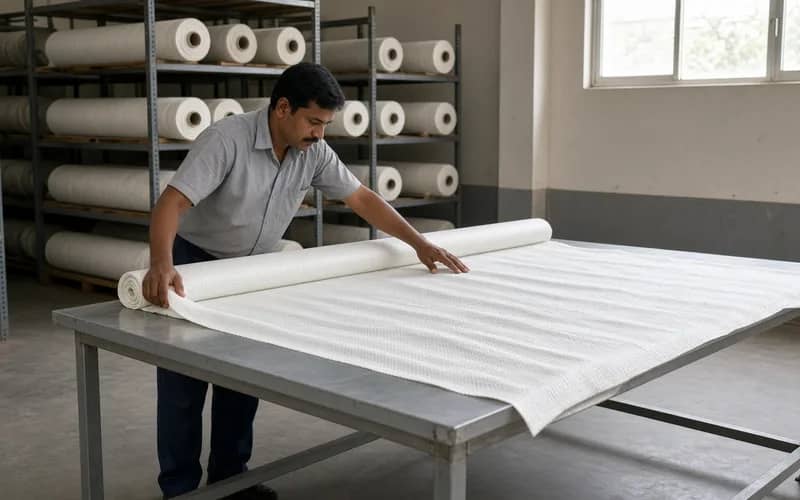
You buy Signature Fiberglass Cloth by the square metre. On the product page you enter length and width in metres. You are not picking a finished blanket off a size chart.
Reference rolls are 1 × 50 m or 1 × 100 m. The four models in the 550 °C to 800 °C window, DSZFG0.1, DSZFG0.18, DSZFG0.2, and DSZFG0.4, use the 1 × 100 m reference. The other models use 1 × 50 m. Those figures describe the reference roll. The order is still the length and width you type.
Leave old roll lists off the indent. Widths of 500 mm, 1270 mm, and 2000 mm, and lengths of 25 m, 30 m, and 200 m, are not on the current model list. If a vendor quote still shows them, ask for the DSZFG model instead of accepting the old size.
Watch the model code. DSZFG0.6 and the other DSZFG codes also appear on the Signature Fire Blanket. That blanket is a different product: a finished piece, sold by number, with its own size. This cloth is sold by the square metre. If the job is to wrap a duct, stay on the cloth. If the job is to smother a small fire, you want the blanket, and this page is the wrong sheet.
Before you send the indent, multiply length by width and check the square metres against the cut plan. Six pipe sections should not turn into one short offcut because the width box was left blank.
If the code says DSZFG and the unit is a number of pieces, you are looking at the fire blanket, not this cloth.


Discussion (0)
Join the conversation
Sign in to leave a comment for our applications team.
Sign in to comment